

Why Limited-Time Offers Feel So Hard to Ignore
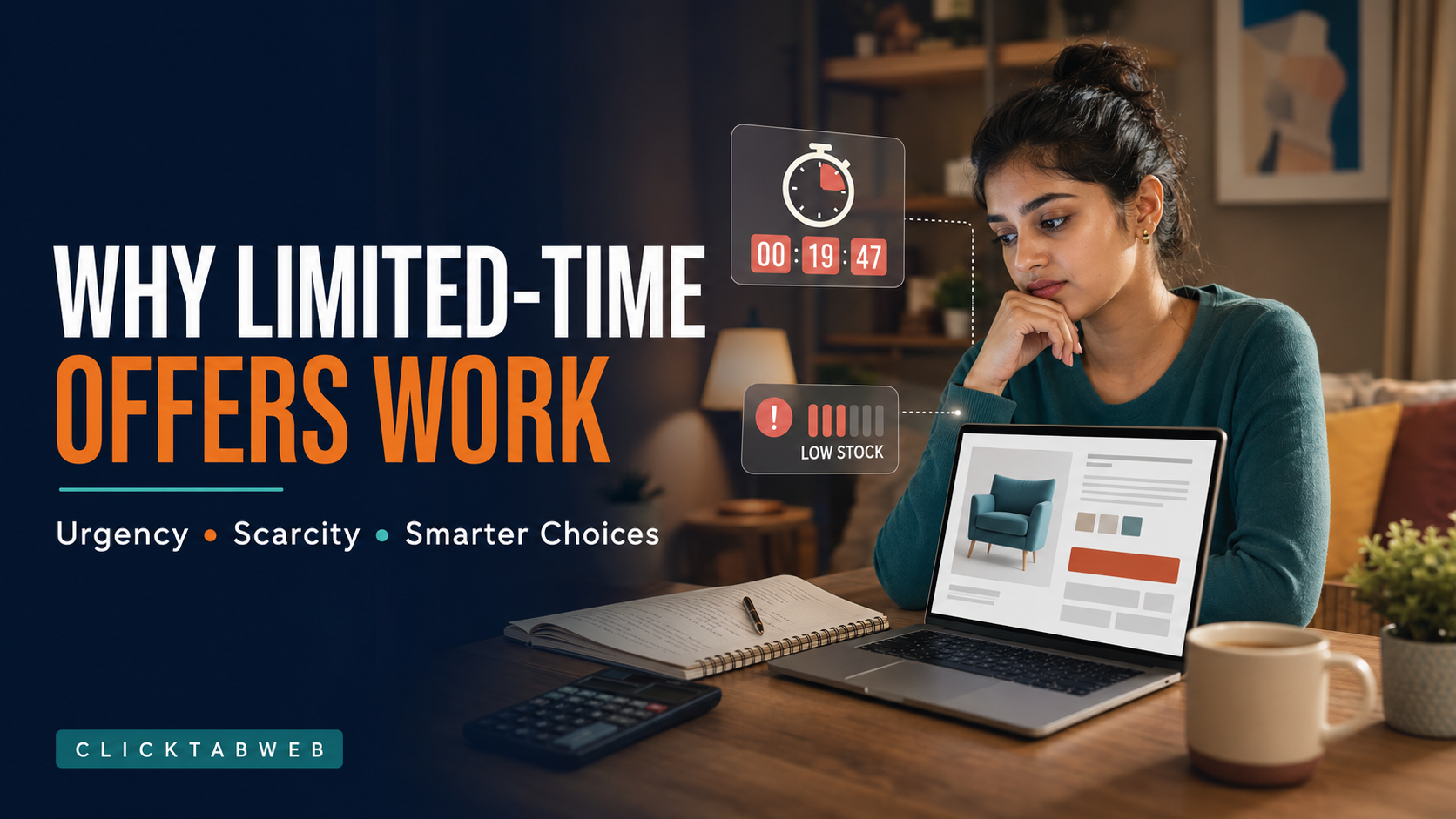
I once bought a product with less than two minutes remaining on a countdown timer. I had not planned to purchase it that evening, and I had not compared the price anywhere else. The timer simply made waiting feel risky.
The product arrived a few days later. It was fine, but it was not something I urgently needed. More importantly, the same “limited-time” offer returned the following week.
That experience made me curious: why do countdown timers and low-stock messages have such a strong effect on our decisions?
The answer lies in the way urgency changes our attention. When an opportunity appears temporary, we focus on what we might lose rather than whether the purchase is right for us.
Urgency Shortens the Decision
A normal purchase gives us time to compare products, read reviews and consider the cost. A limited-time offer introduces a deadline.
The question changes from:
“Is this product useful?”
to:
“Can I decide before the offer disappears?”
That shift benefits the sale rather than the shopper. We become occupied with the clock and spend less time examining the complete deal.
This does not mean every deadline is artificial. Seasonal sales, clearance events and inventory-based promotions can have genuine end dates. The important skill is recognising when urgency is providing information and when it is replacing thoughtful comparison.
Why Scarcity Increases Desire
People tend to value opportunities more when they appear scarce. A message such as “Only two left” can make an ordinary product feel unusually desirable.
Scarcity can be based on:
Limited inventory
A short promotional period
Exclusive access
A one-time coupon
High customer demand
A product being discontinued
Real scarcity is useful information. Problems arise when the message causes us to ignore product quality, price or necessity.
Before reacting, I ask whether the product would still interest me if the low-stock message were removed.
If the answer is no, the scarcity—not the product—is probably driving my decision.
Countdown Timers Create a Sense of Progress
A moving timer is difficult to ignore. Every passing second makes the opportunity feel closer to disappearing.
Even when we know that similar sales happen regularly, watching the timer can create pressure. Closing the page begins to feel like actively giving up a benefit.
My solution is simple: I stop watching the timer.
I open another tab, review the product elsewhere or step away from the screen. Creating physical or digital distance reduces the emotional effect of the countdown.
The Original Price Can Anchor Our Judgment
Limited-time offers often display an original price beside a lower sale price. The higher number becomes an anchor that shapes how valuable the discount feels.
However, the crossed-out price does not tell us:
How other retailers price the product
Whether delivery charges apply
Whether the quantity is different
Whether a coupon requires a larger order
Whether the seller is reliable
Whether the return conditions are reasonable
Instead of comparing the sale price only with the displayed original price, I compare it with the final cost of equivalent products.
When appropriate, I may check a resource such as the ClickTabWeb store and offer directory as part of that research.
A comparison does not need to take hours. Even checking one or two alternatives can provide useful context.
Social Proof Adds More Pressure
Urgency is often combined with messages such as:
“Popular right now”
“Many people are viewing this”
“Recently purchased”
“Trending product”
These signals suggest that other shoppers may take the opportunity first. They combine scarcity with social proof, increasing the pressure to act.
Customer activity can be helpful, but popularity does not determine whether a product suits my needs or budget.
I treat these messages as background information rather than instructions.
Coupons Can Turn Waiting Into a Loss
A coupon with an expiry date feels like something we already possess. Not using it can therefore feel like losing money.
But an unused coupon does not remove money from my account. Purchasing an unnecessary product does.
Before using a time-limited coupon, I ask:
Was this product already on my shopping list?
Does the coupon apply without increasing my cart?
Is the final cost competitive?
Are delivery charges included?
Would I buy this without the coupon?
If the promotion creates the need instead of supporting an existing need, I let it expire.
Cashback Should Not Create a Larger Purchase
Eligible cashback may improve a purchase’s effective cost, but it is generally not an immediate checkout reduction.
A transaction may first appear as pending and require validation. A return, cancellation or ineligible coupon can affect confirmation.
For this reason, I do not increase my budget based on expected cashback. I complete the order only when the checkout amount is affordable without it.
If cashback is later confirmed, I treat it as an additional benefit.
A Pause Restores Perspective
The most effective response to urgency is often a short pause.
My personal rule is:
Five minutes for a small purchase
Several hours for a non-essential purchase
At least one night for an expensive purchase
During the pause, I ask:
Do I need this now?
Do I already own something similar?
Have I checked the exact model and quantity?
What is the final checkout amount?
Can the product be returned?
Would I still want it tomorrow?
The purpose is not to avoid every purchase. It is to make sure the decision belongs to me rather than the timer.
When Acting Quickly Makes Sense
Sometimes a quick decision is reasonable.
The product may be something I already planned to buy. I may know its normal price, understand the return conditions and have money set aside for it. In that situation, a limited-time offer can provide genuine value.
The difference is preparation.
A prepared shopper uses the promotion to lower the cost of a planned purchase. An impulsive shopper allows the promotion to create the purchase.
My Simple Decision Framework
Before responding to a limited-time offer, I now follow four steps:
1. Remove the Timer
I stop watching the countdown and focus on the product.
2. Verify the Need
I check whether the item was already part of my plan.
3. Compare the Complete Cost
I include delivery fees, coupon conditions and product quantity.
4. Accept the Possibility of Missing Out
If the offer disappears before I decide, another sale or suitable product will probably appear later.
Accepting that possibility removes much of the pressure.
Final Thoughts
Limited-time offers are effective because they transform an ordinary shopping decision into a race against time. Scarcity increases desire, countdowns narrow attention and social proof suggests that other shoppers may act first.
Understanding these techniques does not make promotions useless. It makes them easier to evaluate.
I still purchase products during sales. I simply pause long enough to confirm that I want the product—not just the disappearing opportunity.
Understanding the Psychology of Limited-Time Offers
Limited-time offers tap into our psychological biases, making us more susceptible to impulse purchases. One key factor is the concept of scarcity, which can make us perceive an item as more valuable when it's in short supply. This is often accompanied by social proof, which suggests that other people are also interested in the product, further increasing the pressure to act.
However, it's essential to recognize that scarcity is not always a genuine indicator of value. Sometimes, it's simply a marketing tactic designed to create a sense of urgency. To avoid falling prey to this tactic, it's crucial to evaluate the product's value based on its quality, price, and necessity, rather than its perceived scarcity.
The Role of Social Influence in Decision-Making
Social influence can play a significant role in our purchasing decisions, particularly when it comes to limited-time offers. We often look to others for validation and guidance, and when we see that many people are interested in a product, we're more likely to follow suit. However, this can lead to a phenomenon known as 'social proof,' where we make decisions based on what others are doing rather than our own needs and desires.
To avoid being swayed by social influence, it's essential to focus on your own needs and priorities. Ask yourself questions like: 'Do I really need this product?' 'Is it within my budget?' 'Can I afford to miss out on this opportunity?' By taking a step back and evaluating the situation objectively, you can make more informed decisions that align with your values and goals.
The Impact of Emotional Decision-Making on Consumer Behavior
Emotional decision-making can have a significant impact on our consumer behavior, particularly when it comes to limited-time offers. When we're faced with a deadline or a sense of scarcity, our emotions can take over, leading us to make impulsive decisions that we might later regret. This can result in overspending, buyer's remorse, and a general sense of dissatisfaction with our purchases.
To avoid the pitfalls of emotional decision-making, it's essential to take a step back and assess the situation objectively. Ask yourself questions like: 'Am I making this purchase based on my needs or emotions?' 'Have I considered alternative options?' 'What are the potential consequences of this decision?' By taking a more rational approach to decision-making, you can make more informed choices that align with your values and goals.
Key Takeaways
Remove the timer and focus on the product to avoid emotional decision-making.
Verify the need by checking if the item was already part of your plan before making a purchase.
Compare the complete cost, including delivery fees, coupon conditions, and product quantity, to make informed decisions.
Accept the possibility of missing out, knowing that another sale or suitable product will likely appear later.
Don't increase your budget based on expected cashback, and only complete the order when the checkout amount is affordable without it.
Take a pause to restore perspective and ensure the decision belongs to you rather than the timer.
1 followers




Comments (1)
Sign in to join the conversation
The use of countdown timers creating a sense of risk in waiting is fascinating, as it taps into our fear of missing out on a potential deal.